
Why outreach automation needs a state machine before an AI agent
One builder reported spending 44+ hours on a PR outreach build planned for 10. The lesson: build lead status, evidence fields, and approval before AI drafting.
Also available in Korean: Read the Korean original
The first mental picture of outreach automation is usually simple. Drop a lead into a chat, AI researches it, writes a pitch email for a book or podcast, and sends it. In practice, the real work tangles together webhooks, hosting, model choice, brand voice, evidence links, final approval, and failure handling all at once.
What happened: a 10-hour plan that became 44 hours
A self-report posted to Reddit's r/n8n community illustrates this bottleneck well. The poster tried to build a PR outreach workflow to pitch a book and podcast appearances. Triggered by a Telegram message, it was meant to research each prospect, gather sources, an angle, and evidence, and draft a pitch email.
The poster expected the build to take 10 hours. By their own account, it took more than 44 hours, and the workflow still wasn't reliable. What we can confirm is limited. A post-level RSS feed shows the original post and some early comments, but not whether it was eventually fixed or how any real outreach performed. Treat the 44-hour figure as the poster's own self-report, not an independently verified number.
The real failure was mixed responsibility, not weak writing
Reading this as "n8n is the problem" or "AI automation is risky" misses the point. The issue isn't the tool — it's where the responsibilities sit. When hosting stability, workflow state, AI judgment, and brand-voice judgment all get bundled into one piece, any tool becomes hard to maintain.
PR and sales automation bundles at least four separate judgments. Is the workflow running reliably? What stage is this prospect at? What material and angle should the AI draft from? And is this message safe to send under our brand name? Put all four inside one "smart agent" and both debugging and accountability get blurry.
The basic structure: a state machine first
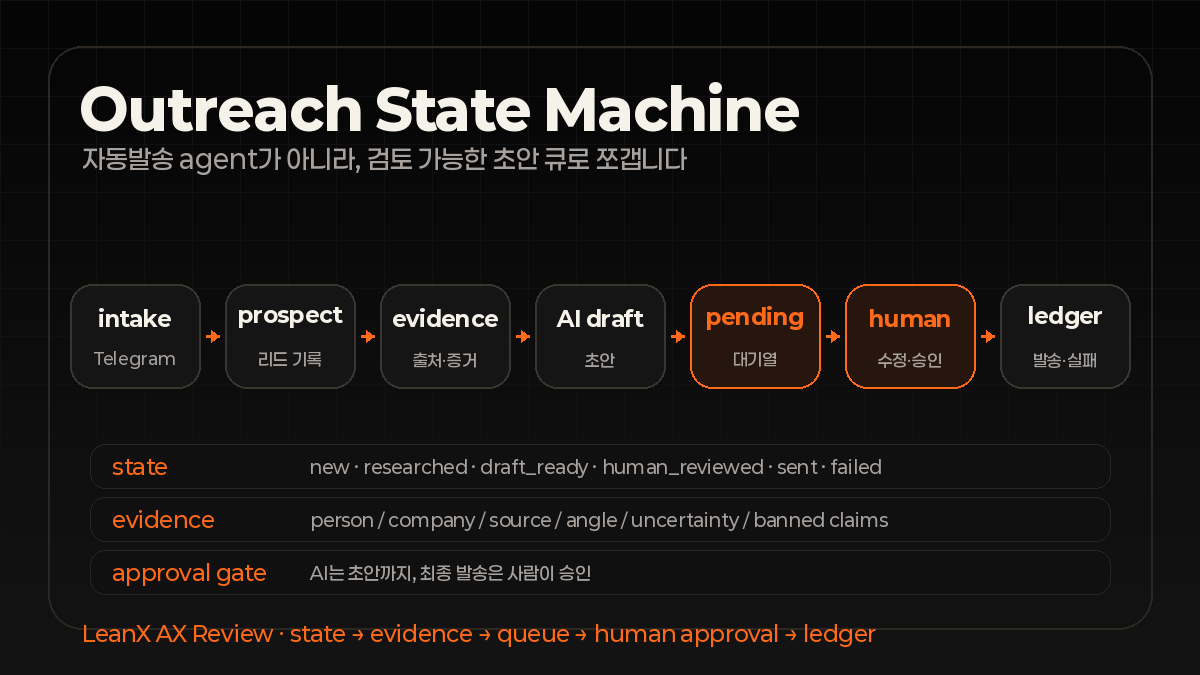
The first design should be a state machine, not an autonomous agent. For example: Telegram intake → prospect record → evidence fields → AI draft → pending queue → human edit/send → sent/failed ledger.
Each prospect needs a visible status, such as new, researched, draft_ready, human_reviewed, sent, or failed. Evidence fields should separate the person and company, source links, why you're reaching out now, the proposed angle, open uncertainty, and any wording that's off-limits.
AI is good at gathering material, proposing an angle, and drafting. But brand voice, the final send decision, and the retry policy after a failure need a human sign-off.
What this means for outreach teams
The first pilot for sales or PR automation shouldn't be a send-it-yourself agent. It should be a reviewable draft queue. Before you scale up volume, build the structure that stops the wrong message from reaching the wrong lead.
- State: track whether a lead is new, researched, draft-pending, reviewed, sent, or failed.
- Evidence: separate company, contact, source, context, angle, and uncertainty.
- Queue: AI drafts sit in a pending queue, not sent automatically.
- Approval: the person accountable for the brand edits and approves the final send.
- Ledger: log sent, failed, and retried, and use it for your next operating decision.
A checklist before you automate outreach
Before picking an automation candidate, check state, evidence, queue, approval, backup and export, and error handling. The easiest path to good AX (AI transformation) isn't AI doing everything end to end. It starts by splitting the task into pieces a human can actually trust and sign off on.
The question to ask before automating isn't "can AI write a good email?" It's "what state is this lead in, on what evidence, and who approves it before it goes out?"
Where to start
Before writing a single prompt, sketch your states and evidence fields on paper. If you can't yet name every state a lead moves through, you're not ready to automate the send step — only the draft step.
FAQ
What is PR outreach automation, in this context?
Using AI and workflow tools to research prospects, draft pitch emails, and track outreach status. Lead state, evidence, and human approval are built in before any message sends automatically.
Sources
Want help picking your first AI pilot?
Book a free call